A Love Letter to Rodney Dangerfield, Eddie Murphy, and Mr. Rogers
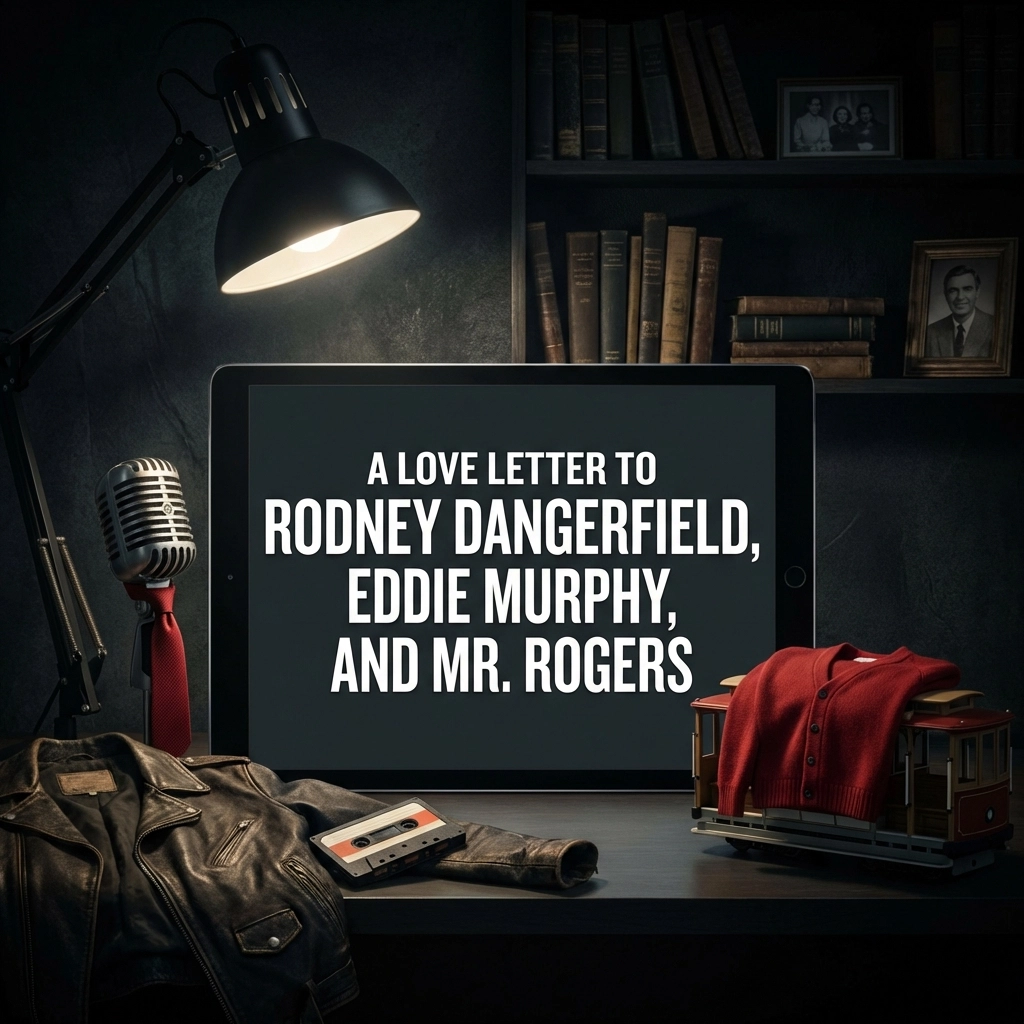
This is a love letter to Rodney Dangerfield, Eddie Murphy, and Mr. Rogers.
Which sounds like the beginning of a joke, a threat, or the world’s most confusing Mount Rushmore, but stay with me.
These three live permanently in my head. They’re the voices arguing while I’m trying to write a bit or shape a piece. One demands precision. One demands electricity. One quietly asks if any of it actually matters. Somehow, they all have a point.
If you’ve ever tried to make something, you know there are always voices in your brain. Mine just happen to wear a red tie, red leather pants, and a cardigan.
Let me explain.
Rodney Dangerfield: The Gold Standard
Rodney is the gold standard — favorite jokes, sure-fire timing, and a ton of charisma.
I still don’t know what’s better: his stand-up or his films. That’s the highest compliment you can give an entertainer. Most people peak in one lane. Rodney paved all of them.
Every word was sharp. Every pause intentional. He wasn’t begging for laughs; he was demanding them, then acting surprised when they showed up.
“I get no respect” wasn’t just a tagline. It was a philosophy. A way of life that made self-deprecation feel like a superpower. And those early movies — Caddyshack, Back to School, Easy Money — are comedic blueprints. No wasted motion. Just relentless precision. He could walk into a scene, say twelve words, and own the frame. That’s not luck. That’s decades of bombing, rebuilding, and refusing to quit. Ten thousand hours, right? Ends up with two good ones, but man, those two count.
When I sit down to write, Rodney is the voice that says: Is the joke tight? Is every word pulling its weight? Cut the fat.
He’s the editor in my head who won’t let me get lazy. He’s exhausting, but he’s right.
Eddie Murphy: Pure Electricity
If Rodney is precision, Eddie Murphy is electricity with a perfect smile.
Eddie doesn’t even have to do anything — I’d watch him sit in a chair and just think. But the thing is, he does everything. Beverly Hills Cop. Dolemite Is My Name. Stand-up specials that still hold up forty years later. Characters, impressions, act-outs so fast they feel illegal.
There’s a moment in Delirious where he does an impression of his aunt falling down the stairs. It’s thirty seconds long. It shouldn’t be that funny. It’s just a man in a red leather suit pretending to tumble. But it’s transcendent. It’s the kind of comedy that makes you angry if you’re a comic, because how is he doing that? How is it that easy for him?
(It’s not easy. He just makes it look that way.)
Eddie proved you could be cool, fearless, and brilliant all at once. He made comedy look dangerous and fun. There’s a swagger to his work that never feels arrogant — like he’s letting you in on something wild.
When I’m writing and a joke is technically fine but feels dead on the page, Eddie is the voice that says: Okay, but is it alive? Stop telling us. Show us.
He’s the one pushing me to take risks and commit fully.
Mr. Rogers: The Quiet Anchor
And then there’s Fred Rogers. The quietest influence, but the strongest one.
This is where it gets weird, I know. What’s a guy in a cardigan doing next to two of the greatest comedians who ever lived? But that’s the point. Mr. Rogers isn’t in my head to be funny. He’s there to ask the harder question: Yeah, but does it mean something?
Everything Mr. Rogers did was built on a pure moral foundation, and he never wavered. Not once. He genuinely cared about people, kids, and feelings. He didn’t chase laughs or applause. He stood for something and let everything else fall where it may.
There’s that famous story of him testifying before the U.S. Senate in 1969 to save funding for public television. He didn’t argue or yell. He just talked, calmly and sincerely, about the emotional lives of children. And he won. Not because he was clever, but because he meant every word.
That’s the part of creativity people don’t talk about enough. The why. You can write the perfect joke and deliver it with electric energy, but it’ll still feel hollow if there’s nothing real beneath it.
Mr. Rogers is the voice that keeps me honest. The one that asks: Are you making something you actually believe in, or just something that works?
The Noise That Makes Sense
So when I sit down to work, that’s the room in my head: Rodney demanding the joke be tight, Eddie pushing it to be alive, and Mr. Rogers quietly asking if it means something.
They have almost nothing in common on the surface. But they share authenticity. Rodney was authentically the guy who never got a break. Eddie was authentically the kid from Long Island who walked into Hollywood like he owned it. Mr. Rogers was a gentle man who genuinely believed in kindness.
And when it all clicks — when the joke is tight, the delivery has life, and it actually means something beyond the laugh — it feels like all three of them nod and say, Okay. Now you’re onto something.
And that’s enough to keep going.